
Note: The procedures for refrigerant charging and
discharging must only be carried out by qualified service
personel who have received specialist training on the air
conditioning system.
JCB Electronic Service Tool Diagnostic Kit High Quality
! WARNING
The air conditioning system is a closed loop system and
contains pressurised refrigerant. No part of the system
should be disconnected until the system has been
discharged by a refrigeration engineer or a suitable
trained person. You can be severely frostbitten or injured
by escaping refrigerant.
4-3-4-1/2
Evacuating (Vacuuming)
JCB ServiceMaster/WinEEM4 KG v2 Keygen
This procedure follows on from the ‘Recovery’ process and
is necessary to ensure proper refilling of the system with
refrigerant.
To avoid leakage in the vacuum system itself, DO NOT use
extensions to the yellow hose (use standard 2 metre length).
1
Recover all refrigerant from the system as described in
Refrigerant Recovery.
2
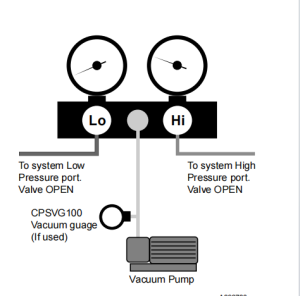
Close all valves and connect the manifold as shown.
Connect the blue hose to the system low pressure port
and the red hose to the high pressure port.
3
Connect the yellow hose to the vacuum pump.
4
Open manifold valves.
5
Switch on the vacuum pump until 740mm (29 in)
mercury vacuum reads on both gauges.
6
Maintain suction for approximately 30 minutes.
7
Close valves and remove equipment.
Section B
Body & Framework
9803/3280
Section B
20 – 3
Issue 1
Service Procedures
Notes:
If the vacuum falls rapidly the system is leaking. Check all
03.2026 JCB ServiceMaster 4 v26.3.2 Diagnostic Software with SW Files Download and installation
Notes:
If the vacuum falls rapidly the system is leaking. Check all
connections and reseal. If the point of leakage is not
obvious, recharge the system and test again. Refer to
Service Procedures, Air Conditioning – Leak Testing.
Achievable vacuum will vary with altitude. Maximum gauge
reading will be 25mm (1 in) less for every 305 metres ( 1000
feet) above sea level.