① The “D” Process of Combustion in a Deutz Diesel Engine: The axis of the inclined cylindrical combustion chamber (as shown in Figure 1-13) intersects the cylinder centerline at an acute angle. Two equal-thickness fuel jets, forming an acute angle (28°), are injected near the walls of the inclined cylindrical combustion chamber. A strong rotating airflow with an intake tangential velocity of approximately 90 m/s (vortex ratio approximately 2.6) propels the fuel jets to the periphery. The fuel-air mixture at the center of the combustion chamber has a suitable concentration and ignites first (ignition delay approximately 2°~3° crankshaft rotation). At the combustion chamber walls, the fuel-air mixture concentration is higher, and due to the lower temperature, the chemical reaction is controlled, preventing immediate ignition. Subsequently, due to the effect of thermal mixing, the combustion gases at the combustion chamber walls flow towards the center. The combustion gases at the center, due to their lower temperature and higher density, are thrown towards the chamber walls under the centrifugal force of the rotating vortex, where they mix again with the richer fuel-air mixture at the walls, further fueling combustion. The Deutz combustion “D” process is characterized by low combustion noise, avoidance of combustion shock during startup, reliable starting at ambient temperatures above -15°C, good fuel economy, and low heat load. The Deutz combustion “D” process is applied to the FL413F series non-turbocharged diesel engine.
② The “Z” Process of Deutz Diesel Engine Combustion The Deutz “Z” process employs a W-shaped combustion chamber (as shown in Figure 1-14). Fuel is injected directly into the combustion chamber at high pressure through a 4-hole injector. The formation of the air-fuel mixture relies on the rotation of air along the cylinder liner axis (swirl ratio 1.7±0.2) and the “compression turbulence” of the
combustion chamber itself.
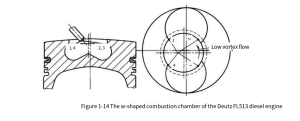
The Deutz “Z” process combustion method achieves better fuel economy, power, and emissions performance than the “D” process. The FL513 and BFL413F diesel engines primarily employ this combustion method. Because the FL513 series diesel engines use a W-type combustion chamber, and with measures such as increasing cylinder displacement in non-turbocharged models, they achieve the same output power at 2300 rpm as the FL413F series air-cooled diesel engines at 2500 rpm, while also significantly increasing low-speed torque and extending engine life by nearly 25%.