
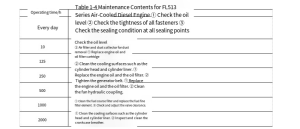
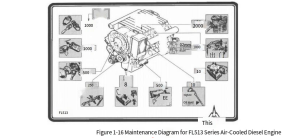
(1) Routine Maintenance of Diesel Engines Routine maintenance of diesel engines is very important and must be consistently performed. It should not be neglected due to concerns about its complexity or necessity. These maintenance tasks are crucial for extending the service life and normal operation of the diesel engine and must be consistently and diligently undertaken. According to Deutz’s maintenance chart (as shown in Figure 1-16), the routine maintenance requirements for the FL513 series diesel engines are shown in Table 1-4.
Deutz Diagnostic Tool Communicator for Deutz Engine DECOM Controllers
(2) Basic Requirements for Regular Diesel Engine Inspections
① Brief Explanation of Regular Inspections. Due to the characteristics of vehicle and construction machinery operation, maintenance during normal use is generally insufficient. Regular inspections of the diesel engine should be conducted during operating breaks, with at least one comprehensive maintenance performed annually. Regular inspections and maintenance of the diesel engine can identify and eliminate various hidden faults, preventing problems before they occur and ensuring stable and reliable operation. Regular maintenance of diesel engines, also known as preventative maintenance, is highly beneficial for extending their service life and improving their efficiency. Therefore, regular inspection and maintenance of diesel engines is a time-saving, labor-saving, and highly effective task that should be consistently performed.
2024 Deutz SerDia 4.0 SerDia2010 14.1.9.3 Highest Level 6 Diagnostic Software
② Diesel Engine External Inspection. Thoroughly inspect the diesel engine’s exterior, observing for any abnormal damage or other problems. Clean the cylinder liners, cylinder head fins, oil cooler, and hydraulic oil cooler ducts with high-pressure air. If possible, high-pressure alkaline water can also be used for cleaning, but after cleaning, immediately start the diesel engine and run it for several minutes to allow moisture on the cylinder liners and other external surfaces to evaporate, preventing corrosion.
③ Injector Inspection and Replacement. The quality of the diesel engine’s fuel injectors directly affects its performance. Because fuel injectors operate under high temperature and pressure for extended periods, they are very prone to damage, causing problems such as poor atomization and dripping. If not replaced in time, it will lead to increased carbon buildup in the diesel engine cylinders, potentially causing serious malfunctions such as piston ring seizure and piston crown melting. Therefore, all injectors should be disassembled and adjusted by a professional. Injectors with poor atomization, dripping, or stuck needle valves must be replaced before use. After replacing the injectors, the injection pressure should be checked. Injectors with excessively high or low pressure should be adjusted to ensure proper injection timing and good atomization performance in each cylinder. The following three points should be noted when checking and adjusting injectors:
a. Injector pressure adjustment must be taken seriously. The pressure of injectors on the same diesel engine should be consistent, with the error as small as possible.
b. Injector pressure adjusting shims must be made of steel. Copper or aluminum adjusting shims must not be used. Never use homemade adjusting shims made from aluminum cans.
c. Injectors from different engine models cannot be interchanged. However, apart from the fuel injectors, other parts of the fuel injector body are generally interchangeable as long as the corresponding injection pressure can be adjusted.
④ Change engine oil and “three filters” (oil, fuel filter, and air filter). Regardless of the time elapsed since the last oil, fuel filter, and oil filter replacement, they should all be replaced during the annual routine inspection. The engine oil passages and oil pan, fan centrifugal filter, air filter, fuel tank, and fuel lines should be thoroughly cleaned.
⑤ Check and adjust valve clearance. Regardless of whether the diesel engine has been running for the required time each year for valve clearance inspection, valve clearance should be checked and adjusted regularly, at least once a year.
Valve clearance inspection and adjustment must be performed when the engine is cold, i.e., after the diesel engine has been stopped and cooled for at least 6 hours. When the diesel engine is fully cooled, the standard valve clearance for the FL513 series air-cooled diesel engine is: intake valve 0.2mm; exhaust valve 0.3mm. This work should be performed by a professional mechanic.
⑥ Turbocharger inspection and cleaning. For the turbocharged version of the FL513 series air-cooled diesel engine, the turbocharger is prone to malfunction due to prolonged operation under high temperature and pressure. Common turbocharger faults include: impeller malfunction and oil leaks (oil leaking into the intake and exhaust pipes). These faults will result in insufficient diesel engine power and excessive exhaust smoke. Therefore, the turbocharger should be maintained at least annually. If necessary, replace the turbocharger floating bearings, seals, or the entire turbocharger assembly. Turbocharger repairs should be performed by qualified personnel.
⑦ Injection Pump Inspection and Maintenance. The inspection and adjustment of the injection pump should be performed by qualified personnel on an injection pump test bench. During adjustment, if oil leaks are found in the plunger or delivery valve, or if there are scratches or severe wear on the surface, the pump should be replaced. The fuel supply to each cylinder of the injection pump should be uniform, with an error of less than 2%. In addition, the following points should be paid special attention to.
a. When replacing the plunger, it is recommended to replace it at the same time, regardless of whether the delivery valve is leaking oil.
b. If the diesel engine cannot be started after a long period of inactivity, check if the fuel injection pump throttle adjustment rack is stuck.
c. If the diesel engine’s smoke and sound are normal, but the engine is weak, check the fuel delivery pump and return overflow valve.
d. When the diesel engine speed is unstable, check if the governor is stuck or if the fuel level in the governor’s cavity meets the required quantity.
⑧ Diesel engine upper part leak inspection.
a. Carefully check the sealing of the valve cover gasket, intake and exhaust manifold gaskets, cylinder head return fuel line, pushrod protector, etc., and replace the gaskets as needed.
b. Carefully check the sealing of all fuel injection pump pipe joints.
c. Carefully check the integrity and sealing of the flame heater plug solenoid valve.
⑨ Fan system inspection and maintenance.
a. Inspect the fan’s appearance; there should be no issues such as the moving impeller bottoming out, missing pieces, or damaged stationary impeller.
b. Inspect the fan drive rubber roller and the fan shaft elastic connecting plate, replacing them as needed.
c. Clean the fan hydraulic coupling.
d. Inspect and clean the exhaust thermostat.
e. Carefully observe and inspect the integrity of the fan drive gear (commonly known as the “grenade gear”) shaft bearings and oil seals.
f. Carefully observe and inspect the sealing and integrity of the fan transmission box.
⑩ Inspect relevant fasteners. Check the tightness of all fastening bolts and the sealing of all oil pipe joints. Tighten or replace any loose or missing screws or nuts caused by vibration to prevent further damage.
For new diesel engines or those put into use for the first time after a major overhaul, it is recommended to retighten the exhaust pipe nut after 10-20 hours of operation.
⑪ Inspect the fuel injection pump coupling.
a. For the FL413F model, carefully inspect the elastic connecting plates on the fuel injection pump coupling. If cracks, deformation, or other problems are found, replace them immediately, and replace the entire coupling assembly as needed.
b. For the FL513 series models, although a rigid coupling is used, the elastic connecting plates still need to be carefully inspected. If cracks or damage are found, replace them.
⑫ Injection advance angle check. When deemed necessary, such as when the diesel engine experiences starting difficulties or black smoke from the exhaust, the injection advance angle should be checked and adjusted.
⑬ Other items that should be checked regularly:
a. Check the diesel engine cylinder compression pressure. The pressure range should be: turbocharged models 2.2~3.0MPa; non-turbocharged models 2.5~3.5MPa.
b. Check the air compressor. Replace the air compressor piston rings or the entire air compressor assembly if necessary.
c. Check the crankcase breather and clean or replace the breather diaphragm.
d. Inspect and adjust the tension of the generator belt and external fan belt, and replace any stretched or damaged belts.
e. Carefully inspect the rubber vibration damping bolts between the diesel engine cylinder head and the hydraulic oil cooler. If damaged, they must be replaced. Otherwise, it will lead to increased diesel engine vibration.