
Note: The refrigerant is heavier than air and will leak
downwards from the defective component. Check in still
conditions but in a well ventilated area.
Hose or pipe connections are likely leakage points of any
refrigerant circuit.
To test for leaks in the high pressure side of the system i.e.
from the compressor output to the expansion valve, run the
air conditioning for a few minutes then switch off the engine
and test for leakage using an electronic leak detector.
To test for leakage in the low pressure side of the system,
switch off the air conditioning and leave for a few minutes
before testing.!
! WARNING
Leak testing in Air Conditioning systems should be
carried out only in a well ventilated area.
Tightening Leaking Hoses
! WARNING
The air conditioning system is a closed loop system and
contains pressurised refrigerant. No part of the system
must be disconnected except by a qualified refrigeration
engineer.
4-3-4-1
The refrigerant hoses have crimped ferrule end fittings. The
hose connectors have an ‘O’ ring seal which compresses
when the connection is tight, creating an air tight seal.
Hoses are used to connect the inlets and outlets of the
compressor, condenser, receiver drier and expansion valve
(the evaporator coil is connected to the expansion valve
within the air conditioning unit using rigid pipes).
If leakage is detected from a hose connector,
either by
means of an electronic leak detector or soapy water, tighten
the connector up and repeat the leakage test. If leakage is
still evident, it will be necessary to de-gas the system and
renew the connector ‘O’ ring seal.
The ‘O’ rings used on an R-134a refrigerant system are of an
HNBR compound and are colour coded green. These ‘O’
rings must be used as some ‘O’ ring materials can become
porous to R-134a systems, resulting in leakage.
Checking Refrigerant Charge Level
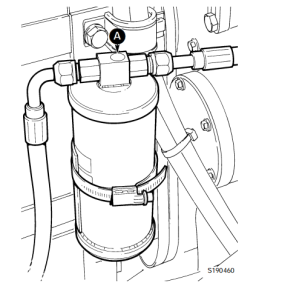
The pressure in the system, i.e. the refrigerant charge level
can be determined by checking the state of refrigerant at the
receiver drier sight glass.
If the level of charge is correct the sight glass will be clear. If
the charge is low bubbles will be seen. Bubbles may also be
an indication of inadequate cooling, due to a restriction of air
flow around the condenser coil. Recharging of the system
should be carried out by an air conditioning engineer. Check
refrigerant charge level as follows:
02.2024 JCB All ECU/ECM/Display Modules Flash File Download
1
Park the machine on firm, level ground. Lower the
backhoe and loader to the ground.
2
Remove the starter key.
3
Remove the front grille.
! WARNING
When the engine is turning, there are parts rotating in
the engine compartment.
Before starting this job make sure that you have no
loose clothing (cuffs, ties etc) which could get caught in
rotating parts.
When the engine is turning, keep clear of rotating parts.
2-3-3-10
4
Start the engine and run at idle. Switch air conditioning
ON to circulate refrigerant.
JCB Electronic Service Tool Diagnostic Kit High Quality
5
Check refrigerant charge level at sight glass A.
Air Conditioning
Leak Testing
Note: The refrigerant is heavier than air and will leak
downwards from the defective component. Check in still
conditions but in a well ventilated area.
Hose or pipe connections are likely leakage points of any
refrigerant circuit.
To test for leaks in the high pressure side of the system i.e.
from the compressor output to the expansion valve, run the
air conditioning for a few minutes then switch off the engine
and test for leakage using an electronic leak detector.
To test for leakage in the low pressure side of the system,
switch off the air conditioning and leave for a few minutes
before testing.
! WARNING
Leak testing in Air Conditioning systems should be
carried out only in a well ventilated area.
BF 1-2
Tightening Leaking Hoses
! WARNING
The air conditioning system is a closed loop system and
contains pressurised refrigerant. No part of the system
must be disconnected except by a qualified refrigeration
engineer.
4-3-4-1
The refrigerant hoses have crimped ferrule end fittings. The
hose connectors have an ‘O’ ring seal which compresses
when the connection is tight, creating an air tight seal.
Hoses are used to connect the inlets and outlets of the
compressor, condenser, receiver drier and expansion valve
(the evaporator coil is connected to the expansion valve
within the air conditioning unit using rigid pipes).
If leakage is detected from a hose connector, either by
means of an electronic leak detector or soapy water, tighten
the connector up and repeat the leakage test. If leakage is
still evident, it will be necessary to de-gas the system and
renew the connector ‘O’ ring seal.
The ‘O’ rings used on an R-134a refrigerant system are of an
HNBR compound and are colour coded green. These ‘O’
rings must be used as some ‘O’ ring materials can become
porous to R-134a systems, resulting in leakage.
Section B
Body & Framework
9803/3280
Section B
20 – 1
Issue 1
Service Procedures
CB ServiceMaster/WinEEM4 KG v2 Keygen