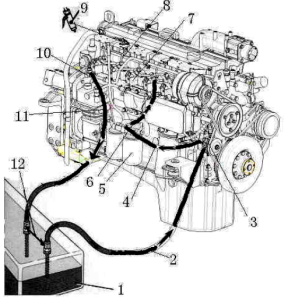
1. Low-Pressure Fuel Circuit Fuel exits from fuel tank 1, passes through diesel pump 3, and enters diesel filter 5. After filtration, it enters injection pump 7 through the injection pump inlet pipe. A portion enters the high-pressure fuel circuit (high-pressure fuel line – injector – combustion in the cylinder), while the excess fuel returns to the cylinder block via the injection pump, forming a low-pressure fuel circuit with a pressure of 5 bar. Stable pressure in the low-pressure fuel circuit is crucial for engine power output. When engine power is insufficient, the pressure in the low-pressure fuel circuit, controlled by pressure control valve 10, should be measured first. Injector leakage (cavitation) is mainly caused by insufficient pressure in the low-pressure fuel circuit leading to cavitation; therefore, timely replacement and cleaning of the diesel filter are essential.
2. High-Pressure Fuel Circuit: Fuel in the low-pressure fuel chamber travels from the injection pump 7 through a short high-pressure fuel line 8 to the injector. When the pressure reaches 220 bar, the injector 9 opens, injecting fuel into the combustion chamber.
3. Fuel Return Flow: Because the fuel supply pump’s output is more than 10 times greater than the injection pump’s output, a large amount of excess fuel flows back to the diesel tank via the pressure control valve 10 and the return fuel line 11. A small amount of diesel fuel leaking during the injector’s operating interval also flows back to the diesel tank via the return fuel line. This serves to cool the combustion process and, by utilizing the large amount of returning fuel, purges air from the fuel circuit, providing an automatic venting function.