
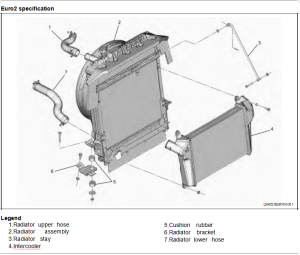
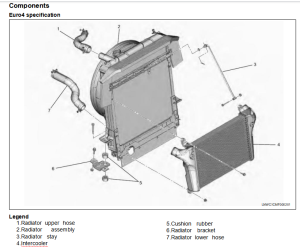
Removal
1.Disconnect the battery cable negative terminal.
2.Drain the engine coolant.
3.Remove the engine cover.(Non-tilt cab model
only)
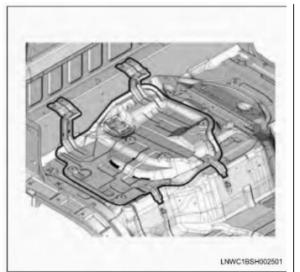
4.Remove tne ariver seat.(Non-tilt cap moael only)
Refer to “FRAME AND CAB”Section 2.
5.Remove the change lever assembly.(Non-tilt cab
model only)
Refer to “Manual Transmission”in Section 7B.
6.Remove the parking brake lever assembly.(Non-
tilt cab model only)
Refer to “BRAKES”in Section 5C.
7.Remove the sub engine cover.(Non-tilt cab model
only)
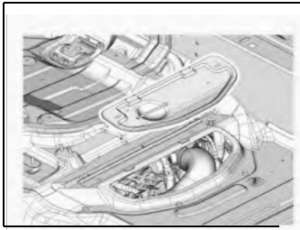
8.Remove the floor support cover.(Non-tilt
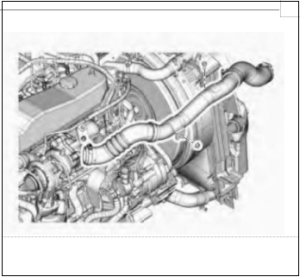
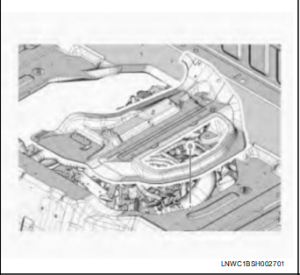
‘9.Remove the air intake pipe and hoses.
·Remove the pipe from the bracket.
·Remove the hose from the intercooler with
the pipe attached.
·Remove the hose from the turbocharger
with the pipe attached.
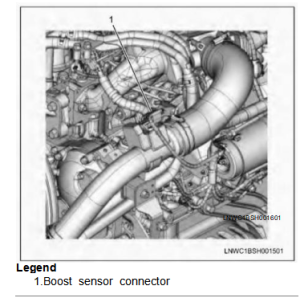
10.Disconnect the boost sensor connector.(Euro4
specification)
11.Remove the air intake pipe and hoses.
·Remove the pipe from the bracket.
·Remove the hose from the intercooler with the
pipe atached.
·Remove the hose from the intake throttle valve
with the pipe attached.
12.Remove the reserve tank hose.
·Disconnect the hose from radiator.
13.Disconnect the radiator hose.
·Disconnect lower hose and upper hose from
the engine.
14.Remove the radiator stay.
15.Remove the radiator and intercooler from frame.
·Remove it carefully from between the left and
right frames,ensuring that the radiator and fan
blade do not touch and get damaged.
16.Remove the radiator from intercooler.
Inspection
Radiator cap
1.Use the radiator cap tester to inspect the open
valve pressure.Replace the radiator cap if the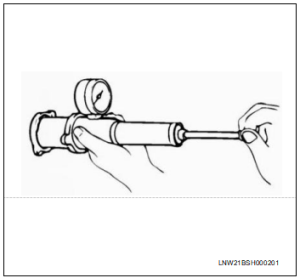
open valve pressure is not at the standard value.
Open valve pressure
93-123kPa(0.95-1.25 kg/cm²/13.5-17.8psi)
2.Inspect the condition of the negative pressure
valve in the center of the capvalve seat side.lf the
valve seat is not operating smoothly because of
rust or foreign matter,clean or replace the radiator
cap.
Radiator core
1.Remove dirt or other foreign matter.
Also,if the radiator fins are deformed,this can lead
to a drop in heat dissipation
and
I cause
overheating.Repair the fins.When repairing,be
careful not to damage the base ofthe fins.
Washing the radiator
1.Wash the inside of the radiator and coolant path
with water.Wash away all scales and rust.
Washing the radiator core
CAUTION:
Do not perform high-pressure washing onto the
radiator,ntercoolerand surrounding parts when they
are still installed on the vehicle.
1.Seal the hose connecting section with a cap or
fabric tape.
2.Sufficiently wet the front and back surfaces of the
radiator.
·Adhering matter which easily comes off witha
splash of tap watershoud be washed off
sufficiently in advance.
NOTE:
Do not use a high-pressure washer or brush.
3.Prepare a mild detergent.
Use a type
which
contains
approx.8%of
surface acting agent.
NOTE:
Do not use anything other than a mild detergent.Use of
any product other than a mild detergent may cause
corrosion.
4.Spray the mild detergent onto both sides of the
fins,and leave them as is for 10 minutes.
5.Rinse off the mild detergent using a high-pressure
washer.
·Start washing from the engine side of the
radiator.
NOTE:
Apply
the high-pressure
water in a
direction
perpendicular to the fins.
·Do not bring the high-pressure water too close to
the fins.
·Be careful not to deform the fins.
6.After washing is finished,inspect the fins to
conirm that the dirt is removed sufficiently.
·If washing is not sufficient,wash them again.
NOTE:
If some dirt is stillef,fine black particles attached on
the fins can be seen.
7.Rinse offthe detergent constituents on the fins and
resin parts using the tap water
8.Remove the seal on the hose connecting section.
9.Clean and
dry the hose connecting section
sufficiently.